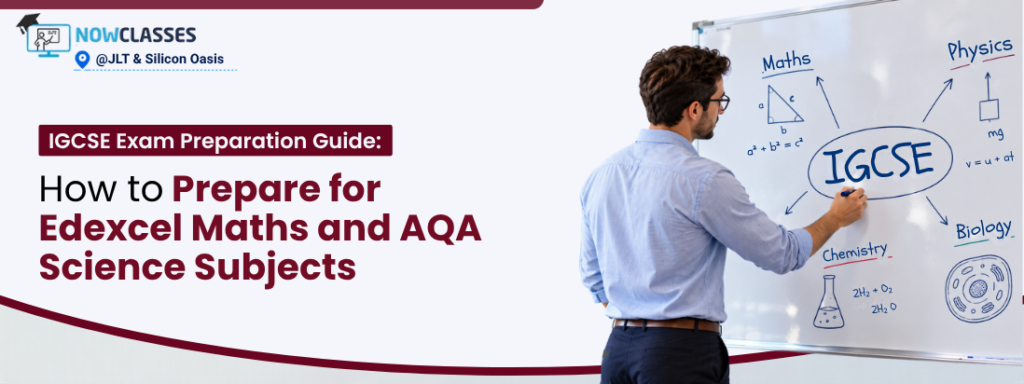
IGCSE Exam Preparation Guide: How to Prepare for Edexcel Maths and AQA Science Subjects
The International General Certificate of Secondary Education (IGCSE) exams test how well students apply knowledge, not how much they memorise. Edexcel Maths, offered by Pearson Edexcel, and AQA Science, assessed by the Assessment and Qualifications Alliance, require focused preparation.
At Now Classes Tuition Centre, we help students approach demanding subjects through structured learning, personalised support, and regular assessment. Our approach begins with understanding where a student stands, then builds subject knowledge through guided practice.
For parents, this method offers a practical way to support progress without creating constant pressure.
Start With The Exam Board, Not The Textbook
Different exam boards can assess similar topics through different question styles. Students should first identify their specification, assessment structure, and required content.
For Edexcel Maths, students should understand the topics within their specification and practise applying methods across varied questions. Maths rewards accurate working, suitable methods, and careful interpretation of problems.
For AQA Science, students need strong subject knowledge alongside application skills. Physics, Chemistry, and Biology questions can require calculations, explanations, diagrams, or analysis.
This distinction matters because revision should reflect the examination students will actually sit. A general textbook cannot replace specification-focused practice.
Build A Revision Plan Around Weak Areas
A useful revision plan should show what needs attention instead of giving equal time to every chapter. Start with a short diagnostic test across major topics.
- Map The Syllabus: List every topic and mark each one as secure, developing, or weak.
- Set Weekly Targets: Choose specific topics instead of setting vague goals such as studying Maths.
- Keep A Mistake Log: Record repeated errors and review them before attempting similar questions.
- Schedule Retrieval: Revisit older topics each week to prevent forgotten concepts.
Now Classes uses assessment and personalised learning to identify strengths and areas requiring improvement. This approach can help students focus their effort where it matters most.
Prepare For Edexcel Maths Through Problem-Solving
Strong Edexcel Maths preparation depends on understanding why a method works. Students should avoid spending revision time copying solutions without attempting questions independently.
Start each topic with concept review, then move towards graded questions. Students should write complete working because method marks can depend on clear mathematical steps.
After each practice set, compare answers with the mark scheme. Identify whether the error involved a formula, calculation, interpretation, or method.
Timed practice should begin once the student has built topic confidence. Full papers should come later, when students can manage mixed topics under examination conditions.
Approach AQA Science As Application-Based Learning
Effective AQA Science preparation requires students to connect scientific knowledge with unfamiliar situations. Simply reading notes can create a false sense of preparation.
Students should explain processes using their own words before attempting examination questions. They should also practise interpreting graphs, tables, diagrams, experiments, and numerical information.
Physics requires attention to formulas, units, calculations, and scientific relationships. Chemistry needs strong understanding of reactions, equations, properties, and practical concepts. Biology requires accurate terminology and explanations of biological processes.
Past questions can reveal how knowledge becomes an examination answer. Students should study mark schemes to understand the detail expected in responses.
Use Past Papers As A Learning Tool
Past papers should not become a final-week activity. Students can use individual questions during topic revision, then complete full papers as examinations approach.
Parents can support this process by asking students to explain their errors. A wrong answer often reveals a missing concept, weak application, or careless reading.
At Now Classes, the learning process includes conceptual learning, practice, doubt-solving, and regular mock exams. This structure helps students connect classroom learning with examination performance.
Students should keep three records during revision: completed topics, recurring mistakes, and mock-paper scores. These records make progress easier to measure.
Create A Sustainable IGCSE Study Routine
Long revision sessions can become difficult to maintain, especially when students manage several subjects. A steady routine can make preparation easier to control.
A student could spend one session reviewing concepts, another solving questions, and another correcting mistakes. Short breaks can separate subjects and reduce mental fatigue.
Students should also protect time for English, Economics, Business, Accounting, or other IGCSE subjects. A balanced timetable prevents Maths and Science from taking over the entire revision schedule.
Now Classes supports students across academic programmes, including IGCSE and A Levels, with flexible scheduling and personalised learning.
Conclusion
Effective IGCSE Exam Preparation begins with knowing the examination board and understanding how each subject awards marks.
Edexcel Maths needs consistent problem-solving, while AQA Science requires knowledge, application, and accurate scientific communication. Students can make stronger progress when they combine specification checks, targeted revision, past questions, and mistake analysis.
At Now Classes, we use assessment, expert guidance, practice, and mock exams to support this process. A focused routine can help students enter their examinations with stronger subject knowledge and greater confidence.
FAQs
How early should students begin IGCSE exam preparation?
Students should begin structured revision months before examinations, leaving enough time for topic review, practice papers, corrections, and final examination preparation.
How can students improve their Edexcel Maths scores?
Students should practise varied questions, show complete working, review mistakes, and use mark schemes to understand where marks are gained.
What makes AQA Science preparation effective?
Students need strong concepts, scientific vocabulary, practical understanding, calculations, data interpretation, and practice with application-based examination questions.
Should students complete full past papers every week?
Full papers become useful closer to examinations. Earlier preparation should combine topic questions, targeted practice, corrections, and selected past-paper questions.
Can Now Classes support IGCSE students?
Now Classes provides personalised academic programmes, experienced educators, assessments, practice, doubt-solving, and mock exams for students preparing for IGCSE and other curricula.